How to Stop Saying Sorry for Every Ordinary Request
Choose between a real apology, empathy, acknowledgment and a direct request. Practice useful wording without ignoring harm or treating politeness as a problem.
A useful first step
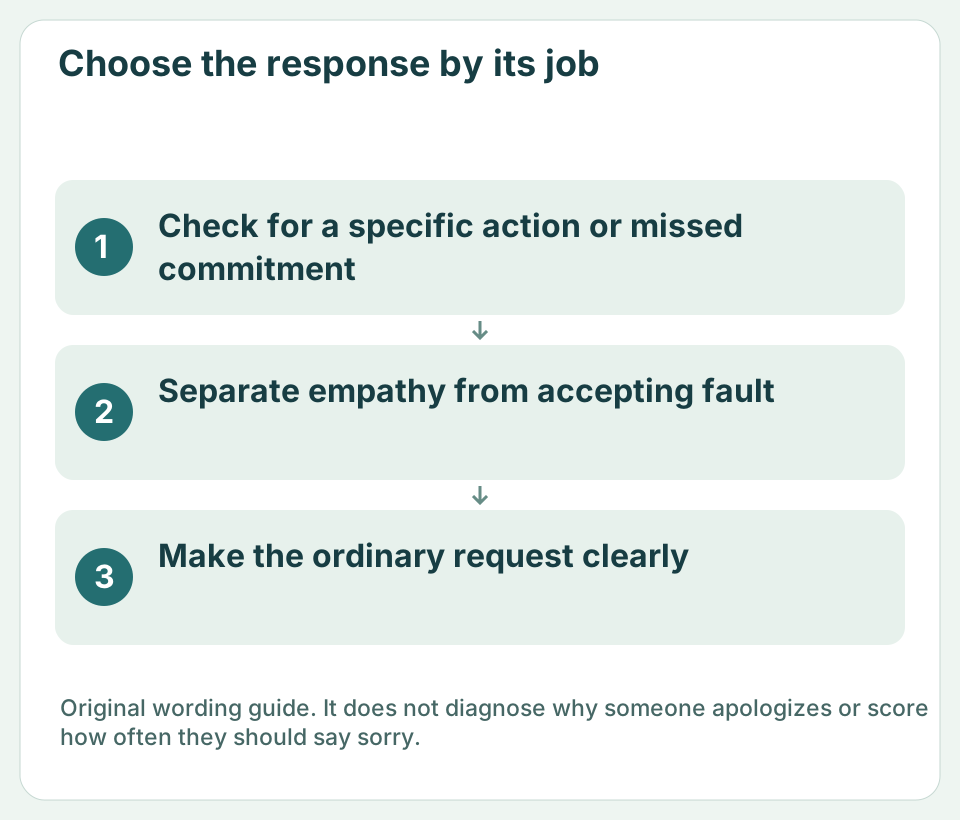
Before saying sorry, check the task: did you cause a specific harm or miss a commitment, are you expressing sympathy, or are you making an ordinary request? Use an accountable apology for the first, genuine empathy for the second and a clear polite request for the third. Do not replace every apology with thank you or force direct wording in a setting where it could be unsafe.
Identify what the word is doing before removing it
“Sorry” can acknowledge a mistake, express sympathy, signal a polite interruption or soften a request. Those uses are different. The aim is not to ban the word or count how often you say it. Ask whether the sentence makes your actual purpose clear, and whether it accepts fault you do not mean to accept.
For example, “I am sorry for your loss” expresses care rather than confessing that you caused the loss. A brief polite apology while interrupting may fit the context. But “Sorry for having a question” can make an ordinary clarification sound like wrongdoing. Choose the wording by the task, the relationship and the setting, without treating every form of politeness as a mistake.
Keep a real apology when there is a real action to own
If you missed an agreed task, shared private information or made an inaccurate statement, name the action and the relevant next step. Do not replace ownership with a cheerful “Thanks for understanding” before the other person has chosen to understand or accept anything. A thank-you cannot complete an unfinished responsibility.
The Ohio State report distinguishes responsibility and repair in written apology scenarios. It does not provide a rule for how many apologies a person should use in daily life. Use a specific apology where it fits the known action, while leaving the recipient free to respond, decline discussion or keep a boundary. Reducing automatic apologies should not become minimizing a genuine effect.
Use a direct request for an ordinary need
A request can be clear and polite without accepting fault: “Could you repeat the last point?”, “I need a moment to check the date,” or “Would this other time work?” Give the relevant information and let the other person answer. You do not have to apologize for existing, having a preference or asking a question that the situation reasonably allows.
Do not turn direct wording into a demand. A request still needs the other person’s choice where agreement is required. “I would prefer another time” is not the same as announcing that everyone must change their plan. Clear wording helps identify the actual decision; it does not guarantee the response or remove formal duties that apply.
| Situation | Possible wording | What to check |
|---|---|---|
| You missed an accepted update | I missed the update we agreed; here is the current information | Keep ownership and practical repair |
| You need clarification | Could you repeat the last point? | An ordinary question is not automatic fault |
| You prefer a different time | Would this other time work? | The request still needs agreement |
| You are expressing sympathy | I am sorry you are going through this | Empathy does not confess responsibility |
| Someone waited and that is known | Thank you for waiting | Do not imply they accepted a separate mistake |
| Refusal could bring retaliation | Use appropriate support before practicing a script | Wording does not establish safety |
Acknowledge inconvenience without guessing agreement
Sometimes you need to recognize a practical burden while the level of fault is uncertain. “I recognize that this change affects your travel plan” can name the effect. If you caused the change or broke an accepted arrangement, add accurate ownership. If it was an unaccepted request or a fact outside your control, do not automatically confess to responsibility for every resulting feeling.
Use thank-you only for something that actually happened: “Thank you for waiting” acknowledges waiting, not guaranteed forgiveness. Avoid “Thanks for being fine with it” when the person has not said they are. Both apology and gratitude should match the facts rather than trying to choose the recipient’s response in advance.
Practice one low-pressure situation rather than rewriting yourself
Pick an ordinary setting where a clearer sentence is wanted and appropriate, such as asking a willing colleague to repeat information. Write one alternative and try it when the task arises. Afterwards, check whether the question was understandable, not whether you used the perfect confident tone. You do not need to eliminate every familiar phrase at once.
This exercise does not explain why you apologize or diagnose anxiety, trauma or a personality trait. Language habits may have many contexts, and a website cannot assess yours. If the pattern is distressing or affects daily functioning, appropriate professional support may help you explore it. A wording sheet is an optional educational aid, not a treatment program.
Check safety and power before changing your wording
A setting with threats, coercion, monitoring or fear of retaliation is different from a low-pressure practice conversation. Do not test more direct wording to prove confidence when doing so could increase risk. Use appropriate specialized support about the actual circumstances. Immediate danger needs local emergency help, and a script cannot make refusal or contact safe.
Workplace, legal, cultural and care settings may also have relevant procedures or expectations. Choose language that fits the genuine task and obligations rather than applying a universal “never apologize” rule. The most useful change is accuracy: an apology for your known action, empathy when you mean care and a clear request when you are asking for something ordinary.
Practice situations
These are original illustrative examples. Use the response only if it fits a wanted, permitted exchange; no result is guaranteed.
You ask a reasonable clarification
In an ordinary work discussion, you did not hear the last date and begin with “Sorry for being difficult.”
What is the actual task?
“Could you repeat the date so I record it correctly?” Use the relevant polite form for the setting.
The sentence asks for information without a global label about yourself. It does not demand a response or decide how formal workplace communication should operate.
You really did miss an agreement
You failed to send an accepted update and want to replace the apology with “Thanks for understanding.”
What would that replacement leave out?
Name the missed action and provide the relevant current information or realistic next step. Thank the person only for something they actually did.
Reducing automatic apologies is not a reason to avoid ownership. Gratitude cannot assume acceptance or complete an unfinished task.
You are offering sympathy
A friend tells you about a loss, and you worry that saying sorry is an unhealthy habit.
Does sympathy mean accepting fault?
Use a caring acknowledgment you genuinely mean, including “I am sorry for your loss” if that fits. You do not need to remove the word simply to reduce a count.
The job of the sentence is empathy. This guide does not score vocabulary or claim that an appropriate expression of care creates responsibility for the event.
You fear punishment for an ordinary no
Someone reacts to your preferences with threats, and you apologize to try to prevent escalation.
Is this the right setting for assertive-wording practice?
Seek appropriate specialized support about the threats rather than using this sheet to test a stronger refusal. Do not treat your wording as the cause of the other person’s threatening behavior.
A safety concern is not an ordinary language exercise. A webpage cannot determine the safest response or guarantee that changing a phrase will reduce risk.
Questions and answers
Should I replace every sorry with thank you?
No. Keep an accountable apology for a known mistake, use empathy when you mean sympathy and thank people for something they actually did. Gratitude should not assume that a person accepted the issue.
Is frequent apologizing a diagnosis?
No diagnosis is made here. This is a wording exercise for a specific task. If the pattern causes distress or affects daily functioning, appropriate professional support may help you explore your circumstances.
Can a request be direct and still polite?
Yes. State the relevant question or preference in an appropriate form and leave room for the other person’s answer. Directness does not mean demanding agreement or ignoring the setting’s genuine obligations.
What if saying sorry feels necessary to stay safe?
Do not use this page as a test of confidence in a threatening or coercive setting. Appropriate specialized support should address the actual safety concern; wording alone cannot make participation or refusal safe.
Choose the response that fits this sentence
The sheet is optional. Use only where appropriate for your privacy and circumstances, and avoid unnecessary identifying or sensitive details.
Download the blank worksheet (TXT)- The situation, described as facts:
- A specific action or accepted commitment I missed, if any:
- Whether I mean empathy rather than fault:
- The ordinary question, preference or limit I want to express:
- A practical effect I can acknowledge accurately:
- A thank-you for something that actually happened:
- One clear polite alternative sentence:
- The agreement or formal requirement that still matters:
- Whether this is a low-pressure appropriate practice setting:
- What needs professional or safety support instead:
Sources and scope
The examples, diagram and worksheet are original educational material. These references support the specific communication, practical-work or support distinctions described in the guide; they do not certify a relationship outcome.
- Utah State University Extension: Communication That Works
University extension education on clear statements, attention, paraphrasing and checking understanding. Our examples do not require eye contact or touch. The referenced underlying papers were not independently read for this guide.
- Ohio State University: The Six Elements of an Effective Apology
University report of two written accounting-job vignette studies with 755 participants, measuring ratings of apology effectiveness, credibility and adequacy. The underlying journal paper was not independently read. This is not proof that these examples produce forgiveness or relationship recovery.
- Utah State University Extension: How to Set Healthy Boundaries
University extension education on identifying and communicating limits. A limit does not replace necessary care, a formal duty or a safety plan. The examples and worksheet here are original.
- U.S. Office on Women’s Health: Get Help
U.S. official domestic, dating and sexual-violence support routes, including a warning that Internet history cannot be completely cleared. This website provides no confidential crisis service, emergency response or individualized safety assessment.
Choose the next guide for your situation
- Check whether guilt points to a real responsibility
A feeling does not automatically turn an ordinary request into wrongdoing.
- Keep genuine ownership specific
When an apology is needed, name the action instead of a global self-judgment.
- Draft a real apology before speaking
Choose concise ownership and an appropriate next step for the known issue.