How to Repair After Emotional Withdrawal or a Missed Update
Identify an actual communication gap, acknowledge its practical effect and offer a manageable next step without treating rest or limited capacity as wrongdoing.
A useful first step
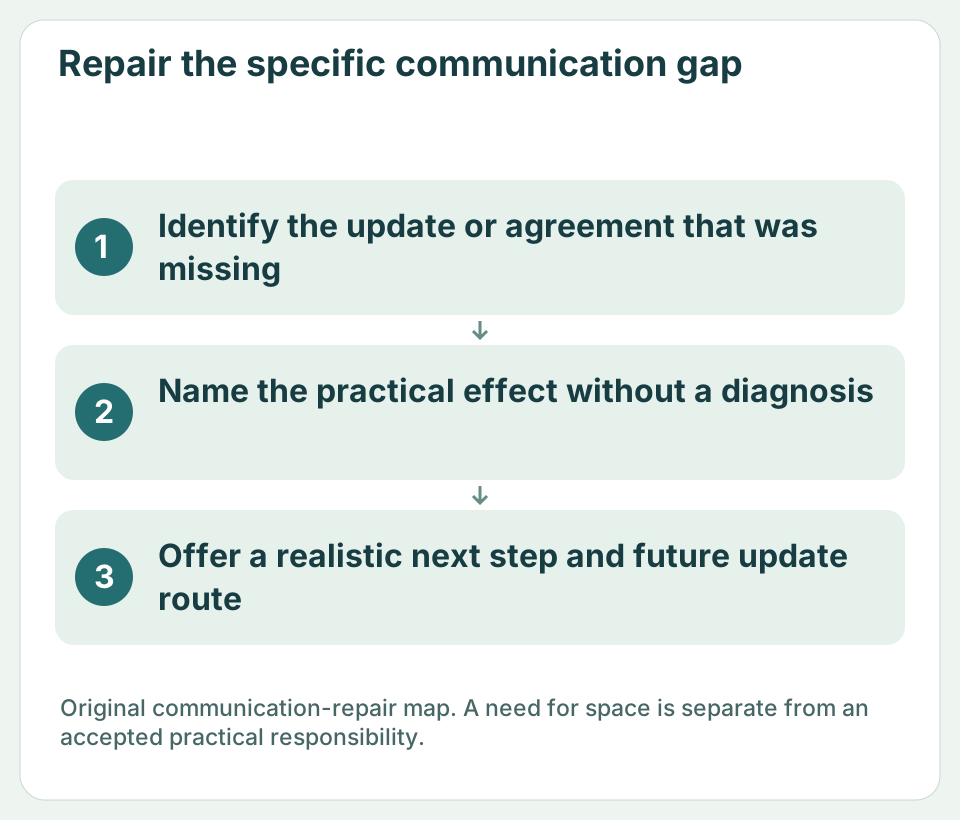
Describe the actual gap rather than diagnosing “withdrawal”: an agreed update did not happen, a shared decision was left uncertain or contact stopped without the information an accepted task needed. Acknowledge the known effect and offer one realistic practical next step if contact is wanted and permitted. Needing rest, privacy or less contact is not automatically wrongdoing, and repair does not require unlimited availability.
Define what “withdrawal” meant in this situation
Use observable facts before a relationship label. You may have stopped replying during a disagreement, missed an agreed planning update or left a shared task without its necessary information. Those facts differ from taking a known break, choosing less personal contact or being unable to communicate because of limited capacity. Do not assume the same motive or responsibility applies to every quiet period.
Write the actual agreement and what did not happen. If no update was agreed and no genuine duty required one, the next task may be clarifying expectations rather than apologizing for needing privacy. If an accepted responsibility was left uncertain, identify that specific gap. This page does not diagnose attachment style, emotional avoidance or the cause of someone’s reduced communication.
Acknowledge the effect without promising permanent availability
You may know that the missing update left someone waiting for a decision or doing extra planning. Name that effect without deciding how they must feel: “I did not send the update we agreed, so you did not know whether the task was covered.” Avoid a sweeping statement such as “I abandoned you” unless it accurately describes the actual issue you are addressing.
You can own a missed agreed action and still need rest or less contact. “I needed space, and I did not communicate the practical update” keeps both facts visible. Do not promise constant replies as the repair. A promise you cannot sustain may produce another uncertain arrangement and does not respect either person’s real capacity.
Offer one limited next step if the exchange is wanted
A first message can state the gap and one practical proposal: provide the missing information, ask whether the outstanding task still needs an answer or offer a feasible time for a voluntary conversation. Keep the message short enough that it does not require the recipient to manage your entire explanation. They can choose whether they want a personal discussion.
If contact has been declined or restricted, do not send the message through friends, a different account or an unexpected visit. Handle genuine obligations only through the appropriate permitted route. A completed apology draft does not establish permission to deliver it, and the other person does not owe a response because you are now ready to talk.
| What actually happened | Question to clarify | Avoid assuming |
|---|---|---|
| An agreed update was missed | What information and practical action remain? | That an apology alone supplies the update |
| A known rest period was needed | Were any accepted duties separately covered? | That needing rest is automatically harm |
| No timing expectation was agreed | What arrangement would both people accept? | That one person’s preference was already a commitment |
| An agreed pause became unclear | Is a revisit still wanted and feasible? | That a break permits indefinite task uncertainty |
| Personal contact was declined | What genuine obligations have a permitted route? | That readiness to talk restores access |
Build an update arrangement that matches actual capacity
For future shared tasks, decide what information is essential and who owns sending it. A brief status update may be enough; it does not need to open a long personal conversation. Agree on a realistic route, an appropriate timing and what happens if the usual person cannot update. Do not make the other person responsible for guessing whether silence means the task is complete.
Keep ordinary personal availability separate from urgent work or care requirements. A delayed social reply is not the same as leaving a dependent person without necessary support. Where health, safety, work rules or care duties matter, use the relevant qualified advice and formal arrangement rather than applying a relationship texting rule.
Use a pause plan only for a pause both people understand
If the issue was a disagreement break, clarify whether a revisit was actually agreed and whether both people still want the discussion. A mutually accepted return time can make a temporary pause less ambiguous. The existing revisit-time guide provides that separate planning task; it does not require a conversation whenever one person asks for it.
Do not use the word “pause” to disguise an indefinitely unresolved accepted responsibility, and do not label a person’s choice to end contact as a break they must return from. A task update, a voluntary revisit and a decision about the relationship are different questions. Address only the question that genuinely remains, with the person’s current contact choice respected.
Check follow-through without scoring emotional openness
Evaluate the actual action: was the relevant information provided, was the revised arrangement understood and did the next accepted update happen? Do not treat the amount of private disclosure as proof of accountability or require a person to expose every feeling before practical cooperation can resume. Trust and renewed closeness remain separate decisions.
The cited communication guidance supports clear statements, listening and checking understanding; it does not diagnose withdrawal or prove a recovery outcome. Threats, coercion, monitoring, stalking, violence or fear require appropriate safety support before a repair attempt. Immediate danger needs local emergency help, and this webpage cannot make contact safe.
Practice situations
These are original illustrative examples. Use the response only if it fits a wanted, permitted exchange; no result is guaranteed.
An agreed task update never arrived
You said you would confirm whether a shared booking was complete, then stopped responding. The other person did not know whether to make another plan.
What repair fits the gap?
If contact is permitted, acknowledge the missed update and provide the current accurate booking status. Identify any practical action still needed without asking for immediate forgiveness.
The problem is missing agreed information. A long explanation about your feelings does not substitute for an accurate status or decide whether the relationship resumes.
You needed rest but made no communication plan
You were overwhelmed and needed less conversation, while an accepted shared responsibility still required an update.
How can both needs be visible?
“I needed space, and I did not provide the update the task needed. Here is the current information; I want a more realistic update arrangement next time.”
Rest and practical responsibility can coexist. The replacement arrangement should fit actual capacity rather than promising round-the-clock availability.
A slow reply was never a broken agreement
Someone calls your delayed personal reply emotional withdrawal, but no response deadline or accepted duty applied.
Is an apology for every delay necessary?
Clarify what availability you can offer and ask whether a mutually workable expectation is wanted. Do not accept a diagnostic label as proof of a missed commitment.
A preference for faster replies is not automatically an existing obligation. Threats or coercive monitoring need appropriate support rather than a more detailed availability promise.
The other person no longer wants discussion
You are ready to explain why you became quiet, but they have said they do not want further personal contact.
What can readiness to explain authorize?
Respect the contact limit. Work on your update pattern and handle genuine practical duties through an appropriate permitted channel only.
Your readiness does not create their consent. Changed behavior can continue without requiring another conversation or collecting proof that they understand your intention.
Questions and answers
Is taking space always emotional withdrawal?
No diagnosis is made here. A need for rest, privacy or less contact is different from a missed agreed update. Identify the facts and any genuine responsibility before deciding what repair applies.
Do I have to explain every feeling when I reconnect?
No. A practical update can remain limited to the task. Personal disclosure and a broader conversation are separate voluntary choices, and the other person may decline contact.
Should I promise faster replies to repair it?
Choose a realistic mutually accepted arrangement for the information that matters. Constant availability may be unsustainable and does not resolve work, care or safety requirements that need their own appropriate process.
What if silence followed threats or fear?
Do not treat the situation as an ordinary communication gap. Seek appropriate specialized support before a direct repair attempt; immediate danger needs local emergency help. A script cannot establish safety.
The missing update and a realistic replacement
The sheet is optional. Use only where appropriate for your privacy and circumstances, and avoid unnecessary identifying or sensitive details.
Download the blank worksheet (TXT)- What communication actually stopped or was missed:
- The agreement or genuine duty that applied:
- What was a need for space rather than a missed duty:
- The known practical effect:
- Accurate information or action still needed:
- Whether contact is wanted and permitted:
- One limited next step I can actually offer:
- A realistic future update owner, timing and channel:
- What requires work, care or other formal advice:
- What should be handled through safety support instead:
Sources and scope
The examples, diagram and worksheet are original educational material. These references support the specific communication, practical-work or support distinctions described in the guide; they do not certify a relationship outcome.
- Utah State University Extension: Communication That Works
University extension education on clear statements, attention, paraphrasing and checking understanding. Our examples do not require eye contact or touch. The referenced underlying papers were not independently read for this guide.
- Utah State University Extension: How to Set Healthy Boundaries
University extension education on identifying and communicating limits. A limit does not replace necessary care, a formal duty or a safety plan. The examples and worksheet here are original.
- Ohio State University: The Six Elements of an Effective Apology
University report of two written accounting-job vignette studies with 755 participants, measuring ratings of apology effectiveness, credibility and adequacy. The underlying journal paper was not independently read. This is not proof that these examples produce forgiveness or relationship recovery.
- U.S. Office on Women’s Health: Get Help
U.S. official domestic, dating and sexual-violence support routes, including a warning that Internet history cannot be completely cleared. This website provides no confidential crisis service, emergency response or individualized safety assessment.
Choose the next guide for your situation
- Agree on a voluntary revisit after a pause
A temporary discussion break needs a mutually understood return arrangement.
- Make texting expectations realistic
Different schedules need clear information expectations rather than constant availability.
- Respect a declined repair exchange
A person may not want another conversation even when you are ready to explain.