How to Accept Consequences After Hurting Someone
Separate practical repair, contact limits and formal obligations after an apology. Four examples show accountability without bargaining for forgiveness.
A useful first step
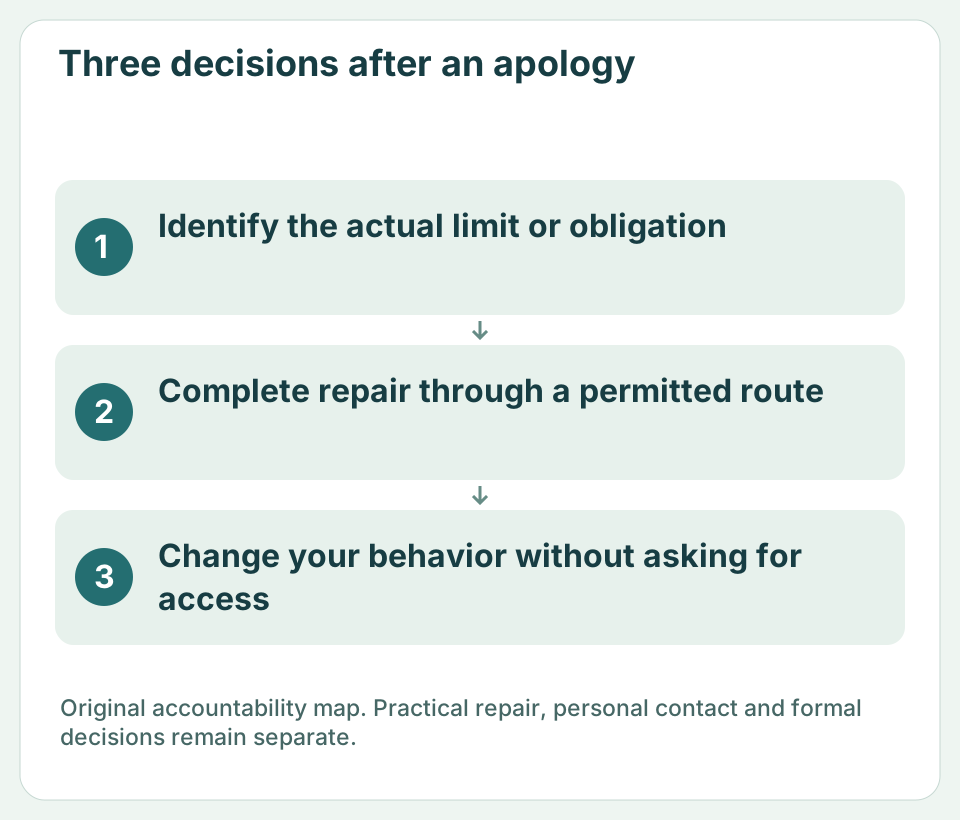
An apology does not reset another person’s boundaries, trust or willingness to spend time with you. Name the consequence accurately, handle practical repair through an appropriate permitted route and change the behavior you control. Get support for your distress elsewhere. Respecting personal limits does not mean accepting abuse or waiving your rights in a formal process.
Find out what consequence actually applies
Write the consequence as a concrete fact: a friend does not want another private meeting, a shared task is being reassigned, or a workplace is using its complaints procedure. Avoid substituting an imagined lifetime judgment such as “Everyone thinks I am a terrible person.” You can respond to a stated limit or an actual process; you cannot resolve a prediction about everyone’s opinion.
Separate what the other person can decide about their participation from what needs a formal decision. A person can decline a social invitation. A financial dispute, employment finding or care arrangement may involve rules, evidence and rights beyond that person’s preference. Use the relevant process for those questions rather than treating an apology as agreement to every demand.
Respect a personal limit without negotiating for relief
If the person says they do not want contact, do not send increasingly emotional apologies, ask friends to deliver messages or appear at places where you expect to find them. Another route to the same unwanted conversation still places the burden on them. Where a response is permitted and needed, keep it short: “I understand that you do not want further personal contact.”
A boundary can be disappointing without becoming an invitation to argue. You do not need to insist that they believe your remorse, give a deadline for reconsideration or hear the entire history of your good intentions. If essential logistics remain, use an agreed or appropriate formal channel and address only that issue; do not add a personal appeal to every practical message.
Do the repair that remains possible
List the repair separately from the apology. A missed commitment may leave an unfinished task; inaccurate information may need correction; damaged property may need an appropriate restitution discussion. Complete what you can legitimately do without requiring private access or an unwanted meeting. Do not make a surprise visit or unagreed transfer the price of your accountability.
An offer still needs the relevant person’s choice or the appropriate procedure. You might state what you can provide and how an authorized recipient can respond, then stop pushing. If the person declines personal involvement, that does not erase a genuine formal obligation; obtain appropriate advice about how it should be handled rather than guessing or asking them to manage your uncertainty.
| What happened | Accountable move | Do not |
|---|---|---|
| Boundary given | Repeat it and follow it | Negotiate for access |
| Practical cost | Repair what can be repaired | Make the apology the repair |
| Trust changed | Let time and behavior speak | Demand a deadline |
| Contact limited | Use your own support elsewhere | Ask them to soothe you |
| Pattern named | Change the pattern outside this moment | Defend the old intent |
Change the pattern outside the apology exchange
Describe the choice that produced the harm and a replacement you can perform. If you repeated private information, stop participating in that sharing pattern. If you missed a deadline without notice, use an owned reminder and a realistic early update. “I will never hurt anyone again” is too broad to guide the next ordinary decision.
Choose a check that does not recruit the harmed person as your supervisor. A task record, a permitted work review or support from an appropriate professional can help you notice whether you did what you intended. Changed behavior is worth doing even if the relationship does not resume. It gives no entitlement to a positive reply, forgiveness or a particular amount of closeness.
Find support for distress without returning it to the person harmed
Remorse can come with embarrassment, grief or uncertainty. Talk to a trusted person who will help you act responsibly, rather than someone who will pressure the other person on your behalf. Explain the relevant facts without repeating private details that caused the original problem. Ask for help with your next action, not a campaign to prove that you deserved a different response.
You can keep a private note of what remains unresolved and still respect a limit. If distress is persistent or difficult to manage, appropriate professional support may help you address it; this page is an educational planning aid. Do not threaten self-harm or suggest that the other person must resume contact to keep you well. Immediate danger needs local emergency or crisis support.
Keep accountability separate from punishment or unsafe demands
Accepting consequences means responding responsibly to legitimate limits and obligations. It does not require accepting violence, humiliation, coercive monitoring or unlimited access to your private accounts. If a proposed “consequence” is unsafe or beyond an informal relationship decision, use appropriate specialized support or formal advice. Do not try to settle a serious safety concern through a more convincing apology.
The Ohio State report on written apology scenarios distinguishes responsibility and repair, but it does not decide legal consequences or guarantee reconciliation. The boundary sources discuss personal participation choices. Apply those ideas to the narrow task of what you control now, while checking genuine work, care or legal requirements through the relevant route.
Practice situations
These are original illustrative examples. Use the response only if it fits a wanted, permitted exchange; no result is guaranteed.
A friend declines another meeting
After you shared private information, your friend says they do not want to meet. You feel an in-person apology would be more sincere.
Does sincerity make the meeting necessary?
If a brief response is permitted: “I understand that you do not want to meet. I will respect that.” Do not ask mutual friends to arrange it.
The limit concerns their participation, not the strength of your feelings. Stop the sharing pattern and handle any appropriate correction without creating another unwanted encounter.
A missed task is reassigned
You failed to complete a shared task. The group assigns the next stage to someone else and asks you to provide the existing work files.
What repair is still yours?
Provide the relevant files through the agreed channel, identify what is incomplete and stop treating reassignment as a debate about whether your apology counted.
Practical cooperation can reduce a remaining burden. It does not require the group to restore the earlier role; formal work rights or procedures should be addressed through their actual route.
A no-contact limit leaves essential logistics
Personal contact has ended, but a genuine shared administrative issue remains.
How can you avoid using logistics as a personal appeal?
Use the agreed or appropriate authorized channel, keep the message confined to the specific administrative action and omit requests for forgiveness or a meeting.
Essential coordination is not permission to restart the relationship. Where a legal or safety restriction applies, seek appropriate advice rather than deciding yourself which channel is permitted.
A proposed consequence includes account monitoring
After your mistake, someone says you must provide all passwords indefinitely or you are not accountable.
Does accountability require unrestricted surveillance?
Separate a relevant practical repair from the monitoring demand and seek appropriate support if refusal could bring threats or retaliation.
A mistake does not make coercion or violence acceptable. This page cannot decide a formal dispute or make refusal safe; appropriate advice and support take priority.
Questions and answers
Can I ask when the person will trust me again?
Do not make trust a deadline they must meet. You can respect the current arrangement and act consistently without asking them to predict a relationship outcome. Necessary practical review dates are a separate issue.
What if the consequence feels unfair?
Separate an unwanted personal decision from a formal finding or unsafe demand. A person may decline contact; work, financial or legal disputes may have a relevant procedure. Accountability does not remove your right to use that procedure.
Should I keep apologizing until they understand?
Repeated apologies can become pressure when a limit has been stated. Complete appropriate repair, change the pattern and respect the permitted contact arrangement. More emotional wording does not create permission for another conversation.
Does respecting distance mean I stop improving?
No. You can change the behavior and seek your own support without using improvement as a reason to regain access. The work remains worthwhile even if the other person chooses no further relationship.
Consequences and owned repair record
The sheet is optional. Use only where appropriate for your privacy and circumstances, and avoid unnecessary identifying or sensitive details.
Download the blank worksheet (TXT)- The actual stated limit or formal requirement:
- What is a personal participation choice:
- What needs the relevant formal process:
- The permitted channel, if any:
- Practical repair I can legitimately complete:
- What needs acceptance or authorization:
- The behavior pattern I will replace:
- How I will check my own follow-through:
- Support I will use without contacting the harmed person:
- A demand that needs safety support or appropriate advice:
Sources and scope
The examples, diagram and worksheet are original educational material. These references support the specific communication, practical-work or support distinctions described in the guide; they do not certify a relationship outcome.
- Ohio State University: The Six Elements of an Effective Apology
University report of two written accounting-job vignette studies with 755 participants, measuring ratings of apology effectiveness, credibility and adequacy. The underlying journal paper was not independently read. This is not proof that these examples produce forgiveness or relationship recovery.
- The Gottman Institute: Setting Boundaries With Others
A life-coach book excerpt distinguishes requests requiring another person’s participation from boundaries about your own participation. It does not grant control over another person or establish safety.
- Utah State University Extension: How to Set Healthy Boundaries
University extension education on identifying and communicating limits. A limit does not replace necessary care, a formal duty or a safety plan. The examples and worksheet here are original.
- U.S. Office on Women’s Health: Get Help
U.S. official domestic, dating and sexual-violence support routes, including a warning that Internet history cannot be completely cleared. This website provides no confidential crisis service, emergency response or individualized safety assessment.
Choose the next guide for your situation
- Respond when an apology is declined
A declined apology does not remove practical responsibility or authorize more contact.
- Handle unresolved feelings without demanding closure
Your need to process the outcome can be addressed without a final conversation.
- Build a specific behavior plan
Translate remorse into an action you can carry out and check.