Practical guide
Apology vs Explanation vs Excuse: Worked Conversation Rewrites
An explanation can accompany an apology. Compare the same situation three ways, keep ownership and context clear, make repair realistic and leave forgiveness or contact voluntary. Includes four original worked rewrites, two comparison tables, a revision record and six practice cases.
An explanation can belong inside an apology
An apology acknowledges what you did or failed to do and takes appropriate responsibility. An explanation describes how it happened. An excuse, as used in this guide, uses circumstances to avoid that responsibility. The difference is what the message does with the context, not whether it contains the word “because.”
For example, “I interrupted because I was trying to answer the earlier point” explains the interruption. “I interrupted you, and I am sorry; I should have waited” owns it. “You were taking too long, so I had to interrupt” puts responsibility on the person who was interrupted. A truthful explanation can accompany an apology without becoming a defense.
| Response | Main function | Small example | Limit |
|---|---|---|---|
| Apology | Acknowledges an action or omission and takes appropriate responsibility. | I interrupted you. I am sorry. I will let you finish. | The recipient is not required to forgive or resume contact. |
| Explanation | Describes relevant circumstances or how something happened. | I was trying to answer the earlier question and spoke over you. | It can accompany an apology, but does not supply ownership by itself. |
| Excuse in this guide | Uses context to avoid or reduce responsibility for the action at issue. | I only interrupted because you were taking too long. | Judge the wording and known facts; do not diagnose the speaker. |
These are reading distinctions, not diagnoses of a speaker’s motives. One sentence may do more than one job, and missing facts can matter. You do not need to decide whether someone is a good or bad person to notice that their message never acknowledges the action at issue.
Use five editing questions, not a compulsory formula
Start with a draft you would naturally say. Mark the action, the known impact, the part you can own, a realistic repair or change, and any demand placed on the recipient. These five editing questions are our original organizing tool; they are not a claim that all meaningful apologies have exactly five parts.
| Editing question | What to check | Small example |
|---|---|---|
| Action | What did I actually do or omit? | I left the shared task unfinished. |
| Impact | What consequence is established, rather than guessed? | You had to complete it before leaving. |
| Ownership | Which part was within my responsibility? | I agreed to do it and did not send an update. |
| Repair or change | What can I realistically do, and what needs agreement? | I can take the next task if you want; I will flag a delay earlier. |
| Response and limits | Am I demanding relief, forgiveness or contact? | You do not have to reassure me or accept that offer. |
Use observable wording: “I did not send the agreed update” is clearer than “Things went wrong.” Where the other person has told you the consequence, acknowledge it accurately. Where you do not know, avoid declaring how they must feel; ask only if a further conversation is appropriate.
Remove “you made me” when it transfers your action to the recipient. Replace an unlimited promise such as “I will never let you down again” with something you can actually do. An offer requiring their involvement remains an offer until accepted. You can own a mistake without accepting an accusation that is not true.
Read the revision once without the contextual sentence. If ownership disappears when the context is removed, the draft may still be only an explanation. Then put back the short context that helps clarify events or prevent recurrence. This is an editing exercise, not a score determining sincerity.
Four situations rewritten three ways
Each set below holds the situation constant. The explanation gives context, the excuse shifts responsibility, and the apology owns the relevant action while retaining useful context. These are original fictional examples, not transcripts or tested interventions.
1. Interrupting a conversation
Situation: You spoke over a friend twice while they were describing a problem. The friend says they could not finish.
Explanation only: “I was trying to answer the first point before I forgot it.”
Excuse: “I only interrupted because you were taking too long to get to the point.”
Apology with context: “I interrupted you twice, and you could not finish. I am sorry. I was trying to answer the first point, but I should have waited. I will let you finish before responding.”
What changed: Keep the relevant context, replace the criticism of the other person with ownership, and name the immediate change. Waiting is something the speaker can do; “you must explain faster” shifts the task back to the recipient.
2. Leaving an agreed household task unfinished
Situation: You agreed to clean the kitchen before a housemate returned. You forgot, and the housemate did it instead.
Explanation only: “I lost track of the task after a long phone call.”
Excuse: “You know how busy I am, so you should not be upset about a few dishes.”
Apology with context: “I agreed to clean the kitchen and left it for you. I am sorry. I forgot after the call; keeping track was my responsibility. I can take the next clean-up if that would help, and I will put the agreed task in my reminders.”
What changed: Replace a demand about their feelings with the actual missed agreement. The offer is not automatically an accepted reassignment. Use the separate household-ownership worksheet if the larger question is who takes responsibility for a recurring task.
3. Sharing a private detail in a group message
Situation: A friend told you something privately. You repeated it in a group without asking. They say they did not want it shared.
Explanation only: “I thought the group already knew about it.”
Excuse: “I was only trying to help; you should have said it was secret.”
Apology with context: “I repeated your private information without checking with you. I am sorry. I assumed the group knew, and I should not have made that assumption. I will not share more. If you want, we can discuss a correction or removal request; I cannot promise that other people have not kept copies.”
What changed: Intent does not erase the disclosure. Keep the repair truthful: asking for removal is different from knowing every copy has gone. Do not spread the detail again while trying to demonstrate that you are fixing it.
4. Leaving a colleague’s contribution out of a shared update
Situation: You wrote a routine project update describing a joint result as your work. A colleague points out that their contribution is missing.
Explanation only: “I reused a draft I had written before your section was added.”
Excuse: “Everyone knows we work together, so there was no need to name you.”
Apology with context: “My update left out your contribution and made the result sound like my work alone. I am sorry. I reused the earlier draft and should have checked it. I will send a correction to the same group naming the joint work, and check the credit before the next update.”
What changed: Name the inaccurate communication, not a sweeping verdict about character. Match a correction to the audience that received the mistake. This example does not determine workplace liability, an employment dispute or whether a particular correction is sufficient.
Keep context truthful, relevant and proportionate
Context is useful when it clarifies a misunderstanding or helps identify what will change. “I used an earlier draft” helps explain a missing contribution and points to checking the final version. “I was stressed” may describe your state, but it does not by itself explain why the other person should take responsibility for the harm.
You do not need to delete every “but,” “because” or reference to an external event. Read the relationship between the clauses. “The train stopped, so I could not arrive; I should have sent an update when I was able” separates an external delay from a controllable omission. It does not claim the transport failure was your fault.
For an unavoidable emergency, regret for disruption can be honest without an invented confession. Give the practical information needed, when safe and possible. You do not have to send private medical records, prove your location or describe someone else’s private circumstances to earn a response. Actual care obligations, contracts and emergencies need their own arrangements.
If facts are disputed, say which part you can establish and which remains unresolved. “I remember the exchange differently, but I did raise my voice, and I am sorry for that” can own a known action without inventing agreement on everything else. A script cannot determine who is legally responsible or settle facts it has not investigated.
Make repair concrete and leave the response voluntary
Match a repair to what happened. A mistaken update may need a correction to the same audience. An unfinished shared task may need a realistic completion plan. A privacy breach may need stopping further disclosure and discussing a correction or removal request, while admitting that other people’s copies may remain outside your control.
Separate action, offer and outcome. “I can send a correction” is an offer or intention. “I sent a correction” describes an action. Neither proves the recipient feels repaired or that a group has read it. Do not make your apology sound complete by reporting an outcome that has not happened.
A recipient can decline an offer, need time, accept the practical correction without reconnecting, or give no reply. Avoid adding “Please tell me we are okay” as the price of taking responsibility. An apology is not a claim on forgiveness, attention or a return to the previous level of closeness.
For a recurring pattern, a new sentence matters less than whether the promised action occurs. Use the shared-task ownership worksheet for an ongoing responsibility rather than making the other person manage your reminders. Use the pause-and-return guide only where a further voluntary discussion is appropriate.
Do not send repeated explanations after a stated contact limit, use a different account to reach someone who has blocked you, or treat “closure” as permission to bypass a restriction. Respect the actual boundary and any relevant legal or safety limits.
What the apology research supports—and what it does not
The Ohio State News report dated 12 April 2016 describes two experiments involving 755 participants. They evaluated apologies in an accounting-job scenario after an incorrect tax return. One experiment described included components; the other supplied written apology statements. The measured outcomes were ratings of effectiveness, credibility and adequacy.
The six components reported were regret, an explanation of what went wrong, responsibility, repentance, an offer of repair and a request for forgiveness. Responsibility and repair were especially important in the reported ratings, while a forgiveness request was least important. The report also notes that responses differed for competence-related versus integrity-related failures and that participants read statements rather than experiencing spoken apologies.
That is a reason to take ownership and realistic repair seriously. It is not proof that a six-component message restores trust between partners, makes a harmed person accept contact, or succeeds in a dangerous relationship. We read the university report, not the entire journal paper. The fictional examples and five-question record here are original educational aids, not validated interventions.
Hailey Magee’s Gottman-published boundary excerpt distinguishes requests involving another person’s cooperation from decisions about your own participation. Applied here, you can choose your changed action; you cannot require forgiveness. The excerpt is public guidance by a life coach, not a trial of these apology rewrites.
Download the revision record and keep safety first
Download the apology revision record with worked examples and six answer notes. It leaves room for the known facts, original draft, edits, practical repair and the recipient’s actual response. Unknown information can remain unknown; an empty response field is more honest than invented acceptance.
ACTION OR OMISSION:
KNOWN IMPACT / WHAT REMAINS UNCERTAIN:
TRUTHFUL CONTEXT, IF RELEVANT:
RESPONSIBILITY I CAN ACTUALLY OWN:
REPAIR OR CHANGE: done / planned / offered / accepted:
RECIPIENT RESPONSE AND CONTACT LIMIT:
REVISED WORDING IN MY OWN VOICE:
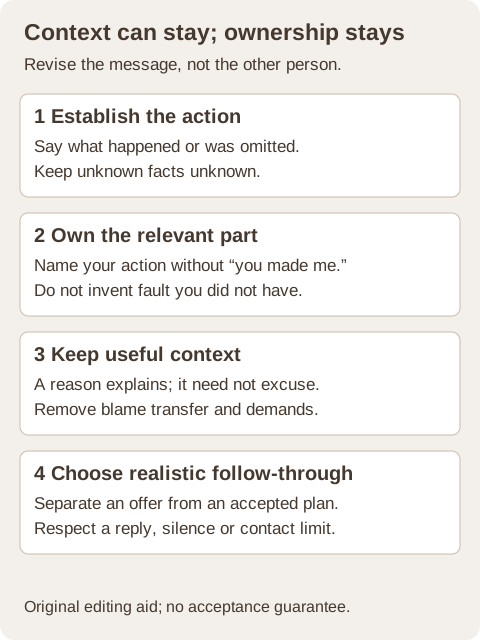
View the four-step revision route. Use it to separate fact, ownership, context and follow-through. The blank download does not collect or assess answers. A completed record can contain private information; save it only where appropriate and safe.
If a situation involves fear, threats, coercion, stalking, violence or retaliation, ordinary conversation scripts are not the main task. Seek suitable confidential local support; use local emergency help for immediate danger. You do not have to negotiate or complete an apology exercise to obtain support.
The U.S. Office on Women’s Health Get help page lists U.S. support routes and warns that someone with device access may inspect browsing activity. Elsewhere, use an appropriate local service. A quick exit does not establish that history is erased; consider a safer device if monitoring is possible. This page cannot assess danger or determine whether contact is lawful or safe.
Six checks for ownership, context and an honest outcome
Try an answer before opening the notes. These original fictional cases examine the draft and its limits, not someone’s character or the future of a relationship.
Case 1
Your draft says, “I am sorry if you were offended, but I was tired.” You did interrupt the person and they say they could not finish. What should be made more specific?
Show answer and explanation for case 1
Name the interruption, acknowledge the stated consequence and keep ownership visible.
A possible rewrite is: “I interrupted you and you could not finish. I am sorry. I was tired, but I should have waited.” The tiredness may be truthful context; it does not transfer responsibility to the other person’s reaction.
Case 2
An explanation is factually true. Does that automatically make the entire message an adequate apology?
Show answer and explanation for case 2
No. Truthful context and acknowledgment of responsibility do different jobs.
Check whether the message identifies the relevant action and addresses the consequence. “I used the old draft” can be true while leaving the missing credit unacknowledged. An explanation can belong in an apology without replacing it.
Case 3
An unavoidable emergency prevented a routine task. Should you invent fault or disclose private medical details to sound more apologetic?
Show answer and explanation for case 3
No. State what is true and address practical effects without inventing blame or unnecessary disclosure.
Regret for disruption can coexist with an honest limit. Separate an event you could not control from an omission you actually could control, if there was one. This exercise cannot establish a person’s obligations or decide responsibility from missing facts.
Case 4
You have asked a group to remove a private message. Can the apology promise that every copy has been deleted?
Show answer and explanation for case 4
No. Distinguish the request from a confirmed result.
Describe what you have done and what remains outside your control. Do not make another disclosure merely to prove the original disclosure is being repaired. Agree on a proportionate next step only if further communication is appropriate.
Case 5
The recipient says they are not ready to talk after your apology. Does a well-written apology give you permission to keep contacting them for closure?
Show answer and explanation for case 5
No. An apology does not create a right to a reply, forgiveness or access.
Respect the stated limit and appropriate contact restrictions. Do not send the same explanation repeatedly or ask the recipient to relieve your guilt. Safety or legal questions require their actual support routes, not a more persuasive script.
Case 6
A university report says responsibility and repair were important in ratings of written apologies. Does it prove these example messages repair real relationships?
Show answer and explanation for case 6
No. Keep the experiment’s setting and measured outcome separate from a real relationship outcome.
The Ohio State report describes written accounting-job scenarios and participants’ ratings. The examples and editing record here are original teaching aids, not a validated treatment or a guarantee of acceptance or long-term trust.
Sources and further reading
- Ohio State News: The 6 elements of an effective apology, 12 April 2016University report on two written accounting-job experiments involving 755 participants, six apology components and ratings of effectiveness, credibility and adequacy. This is the university news report, not the full journal paper or evidence that these rewrites repair relationships.
- Hailey Magee / Gottman Institute: Setting Boundaries With OthersHailey Magee’s published book excerpt distinguishes requests requiring participation from boundaries about one’s own actions. Public guidance by a life coach, not validation of the apology examples.
- U.S. Office on Women’s Health: Get helpU.S. confidential support routes and warning about device and browsing-history monitoring; public page updated 26 September 2025. These resources do not assess a reader’s safety or justify contact.